An Unlikely Parallel: Obituaries and Brands

My first gig out of college was an internship at Bloomberg News, where I wrote obituaries. As an art history major with no financial reporting experience, the Bloomberg editors weren’t sure where to put me, so to the Opinion section I went.
Needless to say, it was an interesting summer, but what it really became was a crash course in storytelling. More specifically, a lesson in distillation. And as I currently find myself in a career rooted in storytelling, I am struck by the similarities between obituary writing and brand strategy.
Obituaries are exercises in clarity. Any obituary needs to summarize the meaning of a person’s life in the first two sentences. Any brand strategy requires the same thing, in reverse: capturing an organization’s defining significance as the tentpole of its future imprint.
One of the obituaries I wrote was for Maya Angelou—no small task for such a legend. The first paragraph of my longer article is the following:
Maya Angelou, the poet and professor whose bestselling memoirs of growing up black and female made her a beloved American storyteller, with a melodious voice and seemingly boundless optimism in the face of hardship, has died. She was 86.
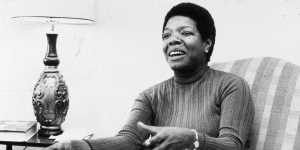
There’s a lot packed in here. It nods toward her identity: the color of her skin, her gender, and her career. But it also articulates what she and her words stood for and why they mattered to everyone she touched. Those first two sentences contextualize her life, express her values, and signal why her absence matters. Angeolou stood for optimism, and she used her voice to quell the everyday anxieties of human beings trying to make sense of their existence.
Writing a brand strategy requires the same constraint with an earlier arc. Where an obituary asks what a life meant, a brand asks what an organization hopes to mean. Both demand prioritization. Both require a near-singular focus. And both are ultimately about legacy.
I am currently helping a client define the brand of their furniture store, as an offshoot of their interior design practice. The goal is to position the store as a complement to the practice: its weirder and quirkier younger sibling. Consequently, it’s my older brother I’m writing about.
The key message I wrote to inform the visual and verbal expression of ‘Furni’ (the store’s placeholder name) is the following:
Furni sources and curates unexpected and quietly brilliant objects for those with the taste—and courage—to choose pieces that spark curiosity and conversation.
I recognize, despite all my brothers’ talents, this is not Maya Angelou. But packed in this singular sentence is Furni’s hopeful mark on the world: to champion objects with personality and bring joy to those who love collecting. Like an obituary, the brand strategy chooses what matters and, in the process, what doesn’t.

The point of this piece is to think about a brand as a declaration of how you hope to be remembered. If someone were writing the obituary of your organization, how would they tee up your larger story? What would they say you stood for, beyond what you sold?
If your organization ceased to exist, what would the world miss?
That answer is your brand, whether you’ve articulated it yet or not.